It's déjà vu all over again
Once again, headlines ping-ponged us around all quarter. Every morning, it seemed, we clocked in to grapple with two competing historical narratives: the war-driven inflation of the '70s and the tech boom of the '90s. We didn't expect the market to take this in stride, but investors entered April in a buoyant mood, swiftly shrugging off Q1's lows. Last year, markets jumped when tariff fears looked overblown; this year, they charged to new highs on the bet that the Iran war would stay contained. Those highs were also fueled by solid job growth and strong earnings across sectors. As we exited May, the AI trade was running hot, and animal spirits went wild.
The market has marched higher for years now on a single belief: a technological revolution is afoot, and it will change everything. What changed this quarter was the leadership. Semiconductors took the lead, leaving the hyperscalers (data center builders) in the dust as the next bottleneck in the capex boom. Performance in semi-land was one for the ages. In just two months, the PHLX Semiconductor Index jumped nearly 70% as fresh money chased the promise of unbridled global innovation. It seemed every time the bell rang on 11 Wall Street, US households and corporations showed up with buy tickets.
By early June, however, the bulls had exhausted themselves. It was no coincidence this fatigue arrived alongside the largest equity raise on record: Alphabet's $80B follow-on, completed weeks before SpaceX's IPO. And with trillions of dollars from private companies waiting in the wings to sell shares to the public, the market, suddenly flush with new supply, began to question when these capital outlays would translate into investor returns.
In our view, the current moment is reminiscent of every major technology revolution: railroads (late 1800s), radio (1920s), PCs and semiconductors (1970s–80s), and the dot-com boom (1990s). Each one has followed the market psychology keenly observed by Sir John Templeton: bull markets are born on pessimism, grow on skepticism, mature on optimism, and die on euphoria. It is too early (and bold) to call a market top, but the behavior we witnessed in the final month of the quarter has us dusting off our history books.
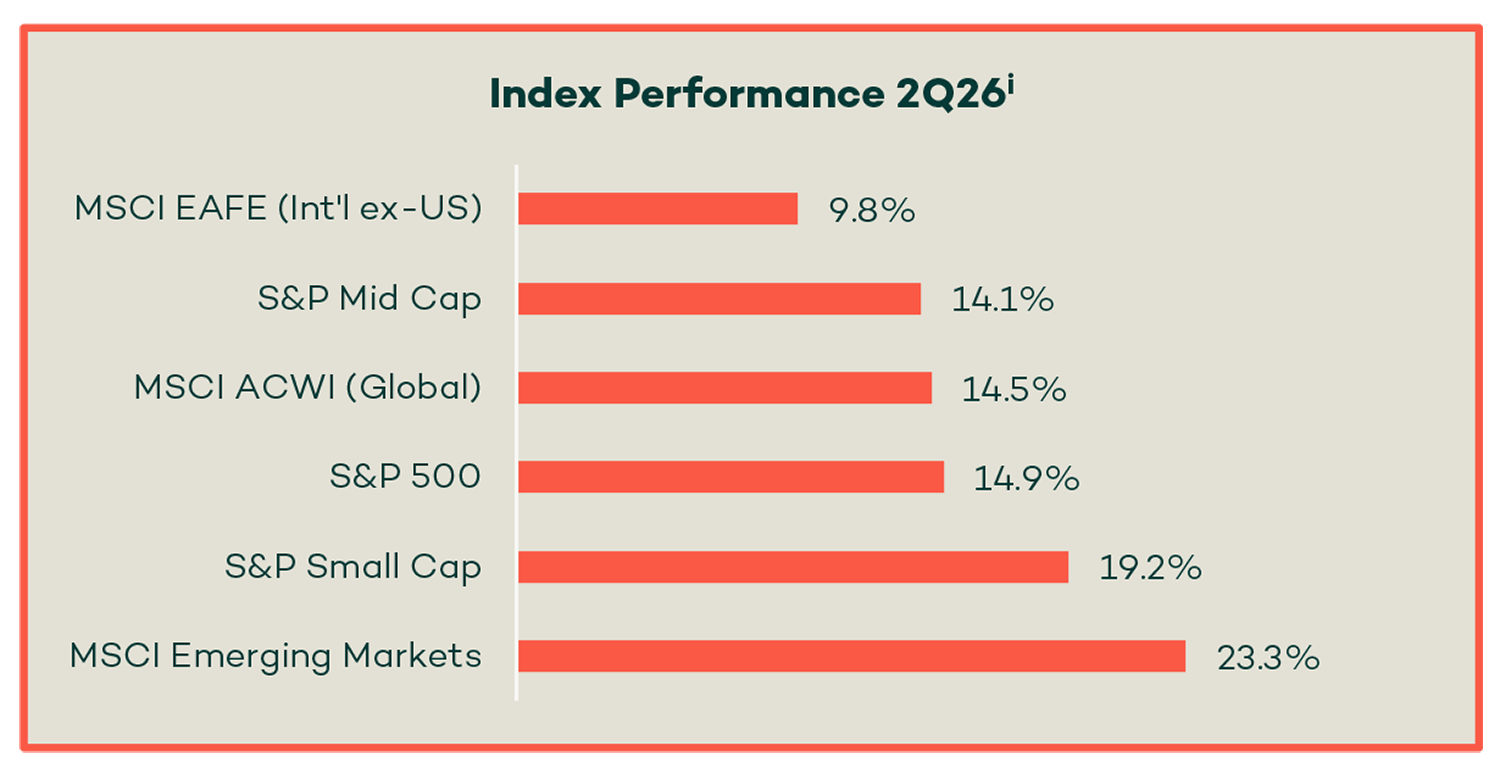
When we tallied up the final score (see chart on the right*), the appetite for risk was plain: it was a profitable quarter for equity investors of all stripes and locales. Emerging markets and small-caps beat US large-caps — the former riding the parabolic moves in South Korea's chip and memory names, the latter buoyed by an elevated risk-seeking backdrop. Broadly, the S&P 500 (+14.9%) and ACWI (+14.5%) posted their quarters on the backs of the same leaders as in recent years: technology and industrial stocks.
The quarter's economic strength and rising inflation (CPI +3.5%) pushed interest rates modestly higher, particularly across the short-intermediate part of the curve. When total returns were published, the Bloomberg Agg finished slightly in the green (+70bps) for the quarter. More striking was the reversal in expectations: many now project the Fed's next move will be a hike rather than a cut.
As we enter the second half of the year, our instinct is that global growth – and higher prices – continue to dominate. With conflicts in the Strait of Hormuz still unsettled, Europe, Japan, and emerging markets have new motivation to spend on rerouting supply chains and building resilience. The associated spending should support a stable market with broader participation, where the average stock finally gets its turn over large index names.
That view comes with a caveat. Since the quarter closed, US strikes on Iran have resumed, putting the very understanding that calmed markets in the 2nd quarter back in question. While we are not in the business of forecasting missiles, we are consistently monitoring how global risks can affect our thesis. One possible risky scenario: energy runs, inflation stays hotter than the Fed can tolerate, rates are hiked, and market exuberance from June meets a discount rate it did not price for. That said, we’ve positioned the portfolio towards businesses with dominant global positions, pricing power, wide moats and a focus on value over price.
Feeding the bulls
Through the quarter, the benchmark MSCI ACWI flirted with all-time highs and our global stock portfolio kept pace. As investors hopped around from one technology bottleneck to another, enthusiasm materially lifted chipmakers and cloud computing (e.g., Intel & Flex), stretching valuations. Alphabet performed well on the back of a new model update and strong quarterly report, outrunning its big tech brethren. Discretionary holdings rode the same strong jobs market that carried the consumer, with Levi Strauss and D.R. Horton rallying.
On the other side of the ledger, two narratives drove most of the headwinds: concerns about overspending and the business threat of agentic AI. Microsoft drew selling pressure after earnings, as its spending binge on infrastructure was called into question. Meanwhile, anything that could plausibly be replaced by AI agents sold off sharply, dragging down software names like Adobe, ServiceNow, and Workday. The fear even reached highly regulated corners like finance, affecting our holdings in Intercontinental Exchange, Willis Towers Watson, and Charles Schwab – businesses where, in our view, the agent threat is likely overblown.
So, as the dispersion picked up, we sold into the enthusiasm, trimming the names the crowd had bid up (Intel, Flex, Corning) and redeploying into the ones fear had just knocked down: ServiceNow, Workday, and our regulated-finance names. As long as the market continues to swing between the AI narrative and the broader capital boom, we plan to swap higher valued names for more reasonably priced franchises. The bigger the swings in individual names, and the more this market rhymes with history, the more opportunity to trim the beloved and buy the feared.
Maintaining the voting machine
The ink on our proxy pamphlets had barely dried before Washington moved to change how companies handle shareholder votes. It began with executive orders early in the administration's tenure and shifted to the SEC, which made the most consequential change of all: it stepped back from refereeing which shareholder proposals a company may keep off its ballot. For fifty years the agency ran a ‘no-action’ review, which told companies, in advance, whether regulators would object to excluding a proposal. No longer. That decision, and the legal risk that rides with it, now falls back on the companies themselves.
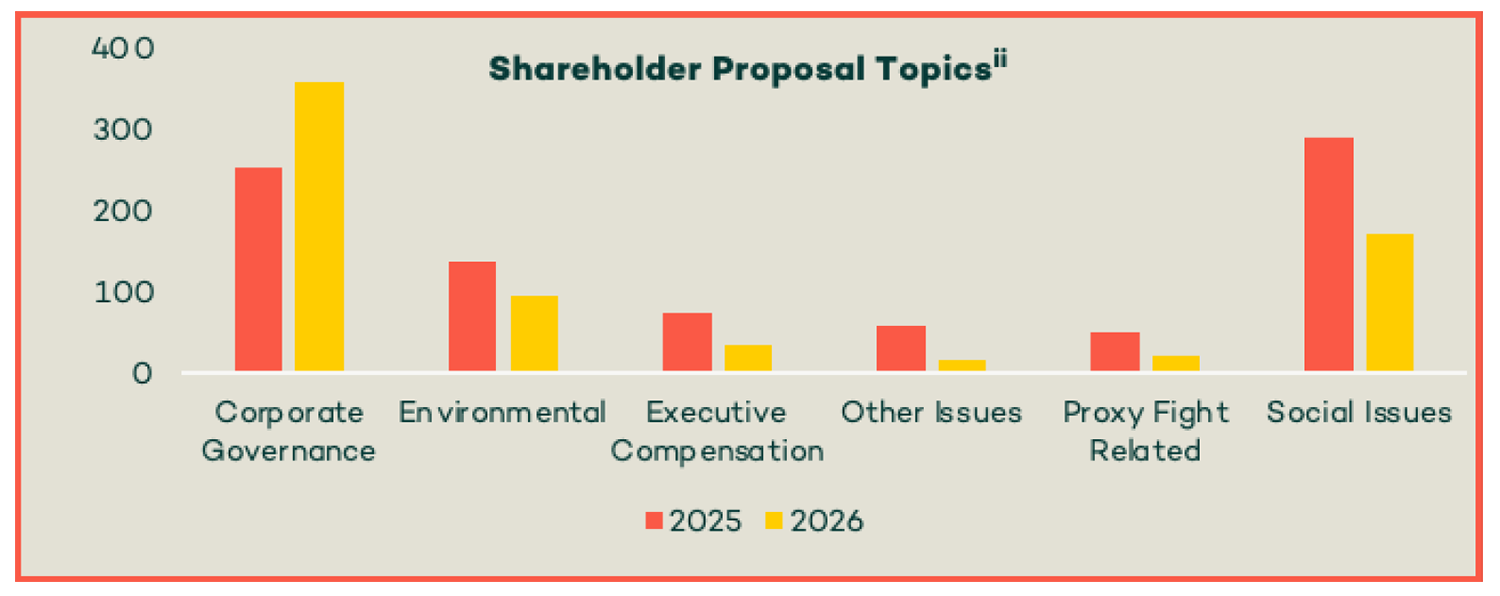
The proxy vote is one of the few tools that lets an owner act like an owner. The regulatory effort to lower the volume on shareholders is already working: overall proposal submissions are down roughly 17%, with the steepest absolute declines occurring in social and environmental topics, while governance-focused proposals became the primary battleground (see chart above**). How the SEC oversees shareholder resolutions is now far murkier and has already led to at least six shareholder lawsuits against companies that have excluded resolutions. Our read on this proxy season is that risks, for shareholders and companies alike, are rising. We have never viewed engagement as a values exercise in isolation. It is about the vulnerabilities that standard financial models miss and that economic reality eventually punishes. Discussions and disclosures around supply chain, a data policy, a giving program, etc., are all places where a mispriced risk can hide. Through direct dialogue, co-filing, and leading proposals this proxy season, we focused on the risks we believe are material to companies we own.
We pressed Costco on where its avocados come from, arguing that illegal deforestation in the supply chain is a material liability and not just a footnote in its filings. Management agreed and tightened its sourcing before a vote was ever needed. We also put forth a proposal to Coca-Cola, seeking transparency on its workforce data. At General Mills, we asked for hard numbers behind its regenerative agriculture program, and its pesticide-reduction strategy. In technology and retail, we addressed the complex issues around data privacy and third-party surveillance at Alphabet and Home Depot, on the logic that a company that puts customer data at risk may very put customer loyalty at risk as well. Here’s a charting of some of our 2026 shareholder engagement work:

As we reach the peak of proxy season, we remain committed to holding management teams accountable. And we are confident that while the rules around the vote may be tightening, the voting machines are still on. If the past has taught us anything it’s that the history of progress has never been a straight line. We will keep engaging and pushing the ball forward to make sure the companies we own are built to compound wealth and make an impact for decades, not quarters.
*i  Performance sourced from Bloomberg
**ii  Jennifer Zepralka et al., “The 2026 Proxy Season: Shareholder Proposal Trends,” Harvard Law School Forum on Corporate Governance, June 11, 2026
You should always consult a financial, tax, or legal professional familiar with your unique circumstances before making any financial decisions. This material is intended for educational purposes only. Nothing in this material constitutes a solicitation for the sale or purchase of any securities. Any mentioned rates of return are historical or hypothetical in nature and are not a guarantee of future returns. Past performance does not guarantee future performance. Future returns may be lower or higher. Investments involve risk. Investment values will fluctuate with market conditions, and security positions, when sold, may be worth less or more than their original cost.