Different strokes for different folks
It's remarkable how often two investors can read the same facts and reach opposite conclusions. Of course, that particular tension is what makes a market. F. Scott Fitzgerald thought a first-rate mind could hold two opposed ideas at once.[i] The market, less ambitious, chose to split into two camps during the quarter: Believers and Skeptics. The sticking points? AI and interest rates.
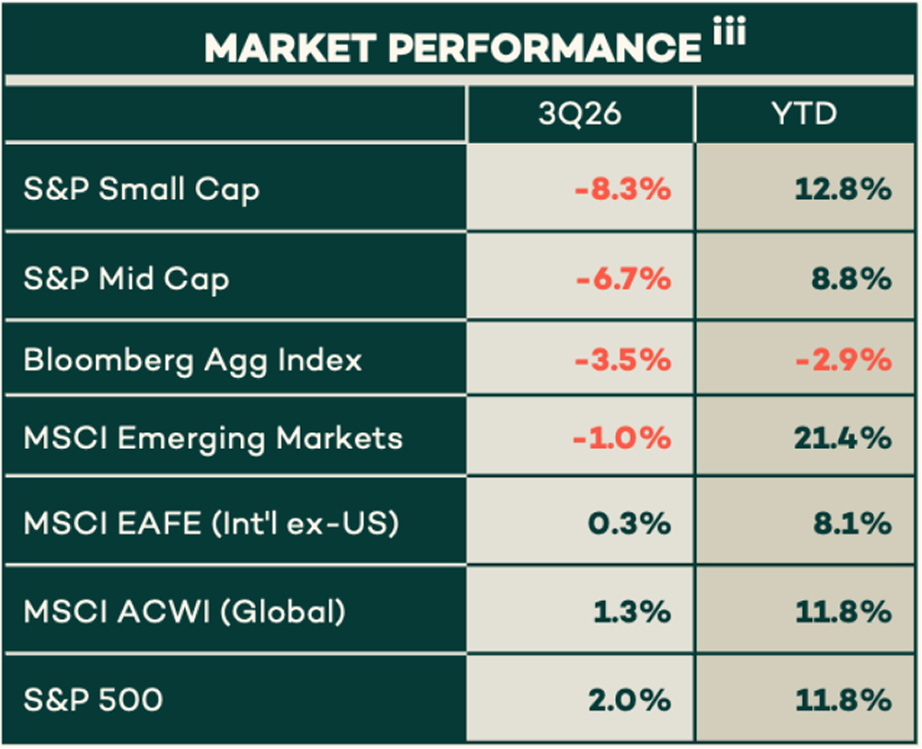
The Believers argue the current investment cycle will benefit humankind through a combination of productivity and abundance. They point to a hot economy, a resilient consumer, and rising corporate profits now supercharged by a capital investment boom unlike anything in history[ii] (read: AI). Even higher interest rates look like good news to this group: a 10-year Treasury yield over 5% signals a strong economy, not the boogeyman many might think. Believer enthusiasm has dominated markets for most of the year. Both the S&P 500 and global equities (MSCI ACWI) have charted strong returns year-to-date[iii], and that includes the past quarter (see table at left). The gains this quarter, though, were concentrated in large-cap companies, which meaningfully outperformed small- and mid-caps.
The Skeptics look at that same 10-year bond over 5% and see a cycle high that’s flashing red. Starting in September, investors repriced the entire yield curve higher, sending the Bloomberg Aggregate Bond Index down 3.5% for the quarter. Skeptics see this rate backup as reflecting sticky inflation, both war- and fiscal-driven. Adding to the unease is a new Fed era under Chair Kevin Warsh. Instead of telling investors where rates are headed, the Fed has left the market to its own devices. And even though concerns aren't showing up in equity prices, Skeptics worry the AI spending boom, which by some estimates accounts for over a third of recent economic growth[iv], could stall. If that happens, the Skeptic camp contends we could repeat the 2000 dot-com bust.
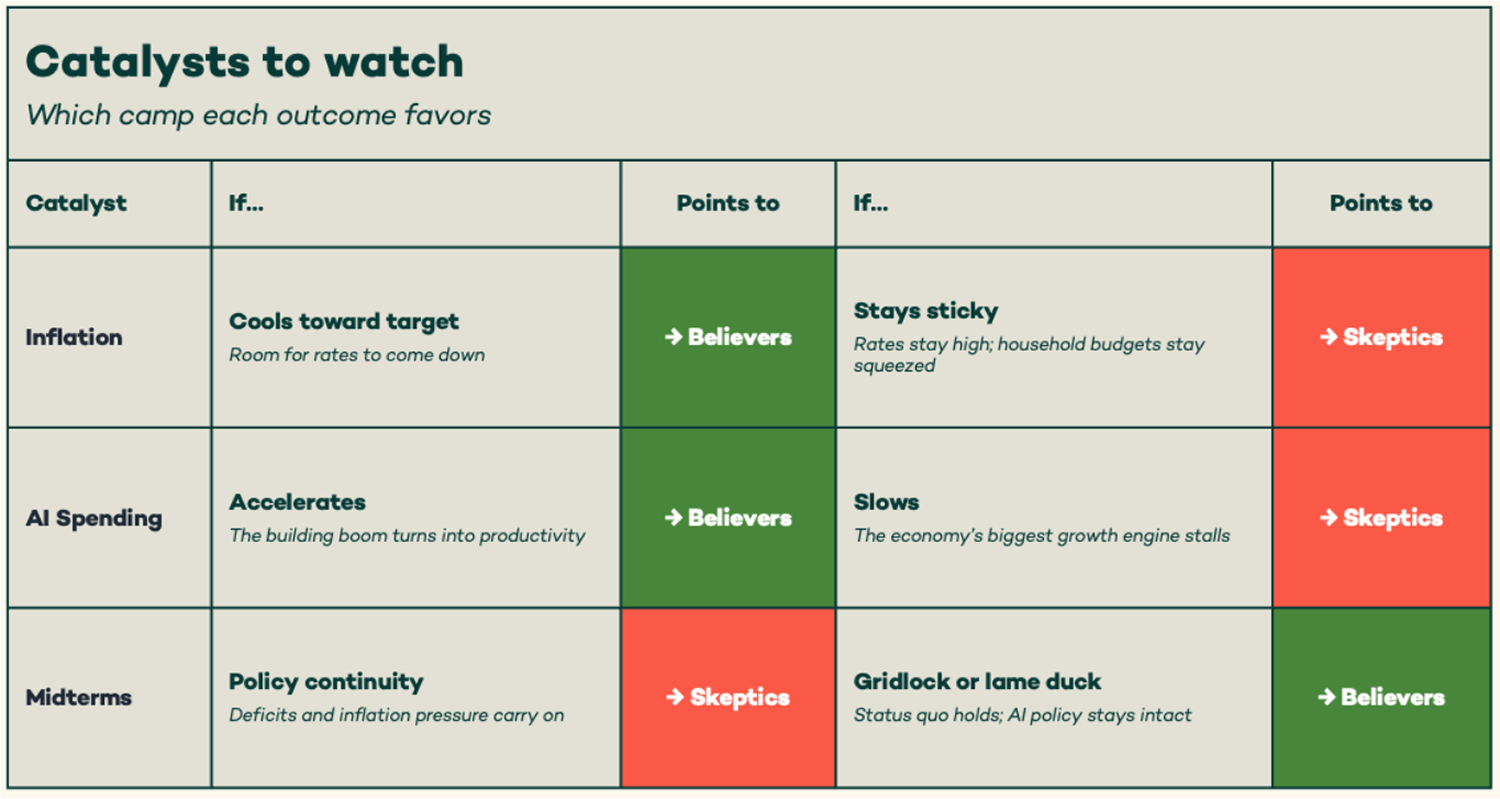
We’re navigating this debate with care, closely monitoring the direction of today’s key indicators: inflation, AI spending, and the results of the midterms (and by extension, the policy backdrop). We don’t intend to wait for the Believer-vs-Skeptic verdict to be settled. When the evidence turns, markets will likely move long before the jury does.
A quarter in the stands
Our diversified global stock portfolios lagged the major benchmarks this quarter, after delivering a strong first half of the year. The biggest detractors were chipmaker and hardware stocks (for example, Intel, Corning, and Flex) that sold off after having soared to nosebleed valuations earlier in the year, as beneficiaries of the AI boom. We’d begun trimming these high-flyers before the 3rd quarter, rotating into beaten-down names the market had deemed AI losers (e.g. software). That turned out to be directionally correct – but not quite bold enough to keep up with the quarter’s market activity.
Adding to the headwind, the quarter's leaders sat largely outside our mandate of global GARP (growth at a reasonable price) companies with a positive sustainable impact. We like growth, but we like it better at a sensible price, and the valuations of this quarter's AI-related darlings were not what we’d deem “sensible.” Oil drillers, defense technology and weapons makers had a fine quarter too, but of course have no place in portfolios built for our clients’ responsible-investment mandate. We watched both rallies from the stands and would again.
Turning to portfolio changes, we stuck to our process and trimmed semiconductors and data-center beneficiaries further. For most client accounts, that again included Intel, Corning and Flex, and we also lowered our weight in TSMC, the world's largest contract chipmaker. We put the proceeds into software (ServiceNow and Microsoft) and added to Netflix on weakness after its HBO deal was terminated. We also took the opportunity brought to us by the market and added two new names to the portfolio:
Colliers International (CIGI): A global real estate services firm the market prices as a cyclical broker, despite roughly 70% recurring revenue. Its engineering arm serves long-term demand for climate-resilient buildings. We bought at a historically wide discount to earnings.
Trimble (TRMB): Maker of the GPS-grade survey gear used on construction sites, now selling the software that runs on it by subscription. That shift supports a 30% operating-margin target, and its decarbonization targets are science-based.
Over time, as the Believers-and-Skeptics debate plays out, we think the market will pay a premium for sustainable companies that deliver for all stakeholders: customers, investors and society.
The Alphabet Economy — redux
For the last 12–18 months, the U.S. economy has been especially K-shaped. Households at the top of the income and asset spectrum continue to benefit from strong wage gains and rising financial wealth. Lower-income households face slower wage growth and rising credit stress (as we discussed in our 4Q25 letter here). This divide has existed for generations, but the gap is once again widening.
We don't see a major risk this quarter, largely because massive equity gains at the top of the K are fueling robust spending[v]. But if the Skeptic narrative described earlier takes hold (e.g., AI spending slows and equity values decline), American consumers likely won't be able to support a soft landing.
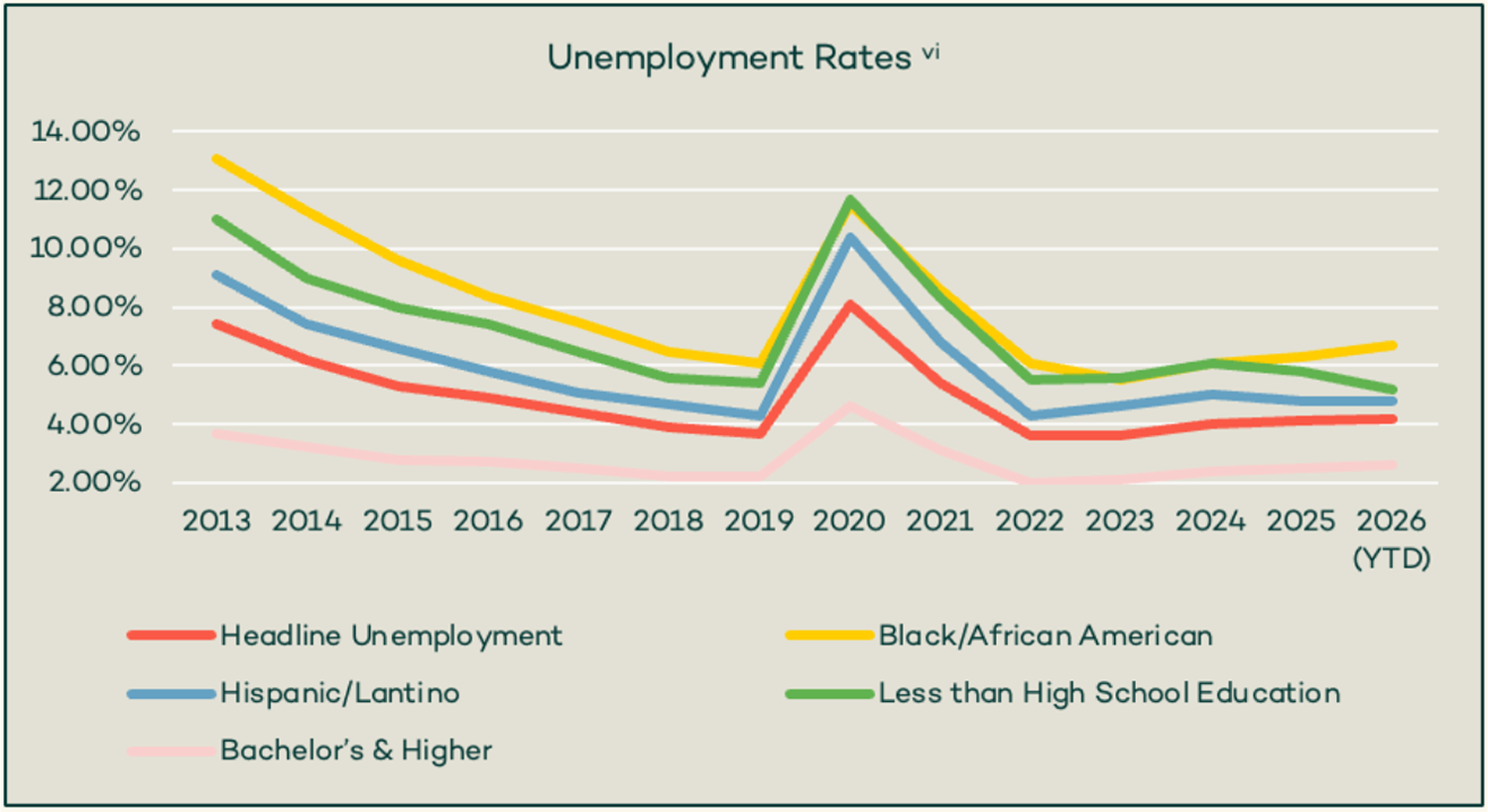
So far, the job market looks to be softening, but not dramatically. Net job creation slowed to 29,000 in September[vi] with growth mostly in categories like healthcare, leisure, and construction. Layoffs remain historically low, but hiring has slowed sharply. We are in what pundits call a low-hire, low-fire environment. If you currently have a job, it appears secure. But for workers who rely on entry-level churn or moving up, the ladder has stalled.
Unemployment is still low by post-2008 standards, but it has risen about half a percentage point since the 50-year lows of 2022. Notably, the unemployment rate for Black workers remains high and rose to 7% in recent months. In past slowdowns, Black unemployment has risen further and stayed elevated longer than the national rate.[vii] So when it jumps, we pay attention to the impact on households and communities, as well as what it says about where the overall labor market may be headed.
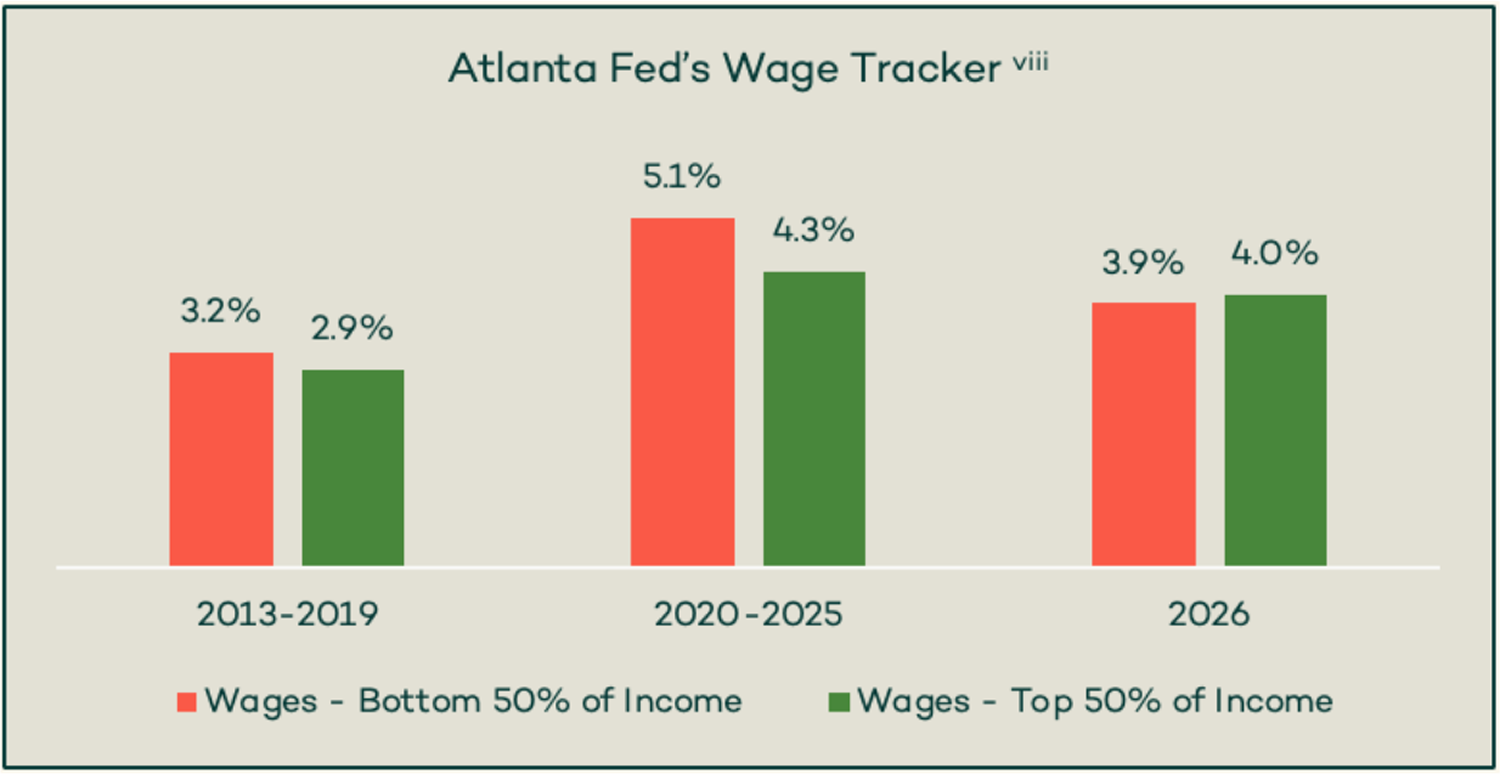
Real wage growth (pay after inflation) is one place we may see cracks emerging. From 2020 to 2025, wage increases for the bottom half of earners outpaced both inflation and the wage gains for the top half of earners.[viii] That pattern may now be shifting, as the most recent data, through August, shows that lower earners merely keeping pace with inflation.[ix]
Inflation doesn't hit every household equally. Households that rent, drive to work, and have little investment income feel something close to the headline rate, or worse. Conversely, a household with a locked-in mortgage and a compounding brokerage account feels far less. In our view, real pay has to be judged against the basket a group actually buys.
We will watch inflation and its drivers closely. Inflation is a regressive tax: if the price of everyday goods keeps climbing, the households least able to pay will pay most, and an economy leaning on the top of the K has fewer legs to stand on.
[i] https://www.goodreads.com/quotes/22749-before-i-go-on-with-this-short-history-let-me
[ii] https://www.wsj.com/economy/the-ai-build-out-is-becoming-the-biggest-economic-bet-in-u-s-history-c60716dd
[iii] Performance figures sourced from Bloomberg and Black Diamond
[iv] https://www.stlouisfed.org/on-the-economy/2026/jan/tracking-ai-contribution-gdp-growth
[v] https://www.nytimes.com/2026/07/22/business/economy/stocks-economy-ai.html
[vi] Data & charts sourced from US Bureau of Labor Statistics – Current Employment Statistics (CES)
[vii] https://www.marketplace.org/story/2026/10/06/why-the-black-white-employment-gap-is-growing
[viii] https://www.atlantafed.org/research-and-data/data/wage-growth-tracker
[ix] https://www.epi.org/chart/figure-v2-average-annual-real-wage-growth-across-business-cycles-by-percentile-1979-2007-2007-2009-and-2019-2024